



Quick summary
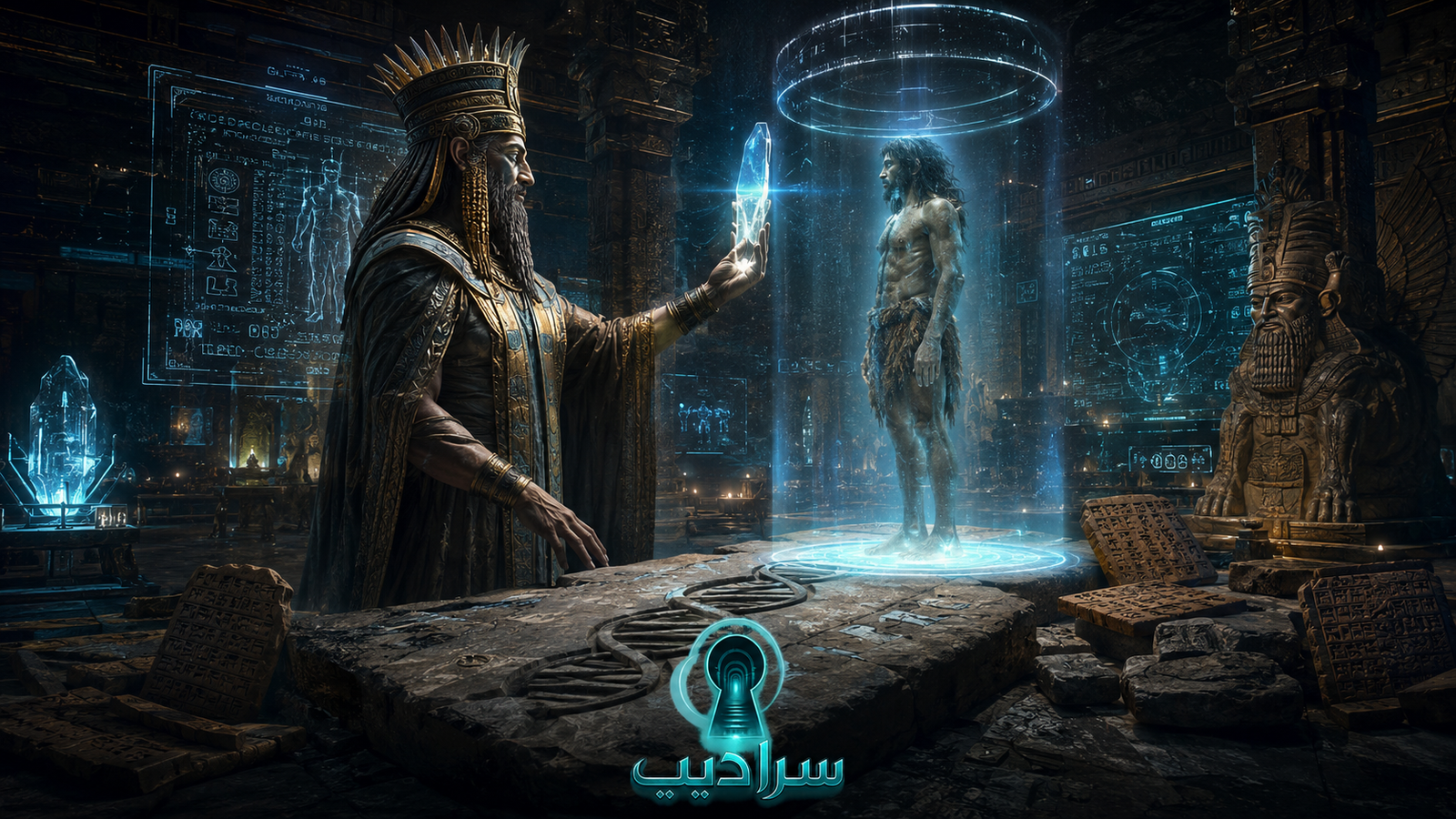
- For thousands of years, the inhabitants of Mesopotamia left behind clay tablets filled with myths, gods, and the creation of man.
- Among these, the name 'Anunnaki' remains one of the most intriguing, especially as it has transitioned from historical study into the realm of anci…
NavigationIn this article
For thousands of years, the inhabitants of Mesopotamia left behind clay tablets filled with stories, prayers, myths, and accounts of gods, kings, the flood, and the creation of man. Among the names that appeared in those ancient texts, the name Anunnaki has remained one of the most intriguing, especially after it moved in the modern era from the scope of historical studies into the world of ancient astronaut theories.
So, who were the Anunnaki really?
Were they merely gods in Sumerian and Babylonian beliefs, or do the ancient stories hide something entirely different? And are there truly tablets that say they came from the planet Nibiru to Earth in search of gold, then created humans to work in their stead?
To answer this, we must start from the only place that can provide us with a real foundation for discussion: the cuneiform texts themselves.
Who are the Anunnaki in ancient texts?
In Sumerian, Akkadian, and Babylonian sources, the Anunnaki appear as a group of gods within the ancient religious beliefs of Mesopotamia.
However, their image was not uniform or fixed throughout all eras.
The civilizations of Mesopotamia spanned thousands of years, with successive cities, kingdoms, languages, and different religious traditions. For this reason, the roles and attributes of some gods changed over time.
In some texts, the Anunnaki appear among the pantheon of great gods associated with divine authority and the determination of fates.
In other texts, some of them are associated with the underworld and the judgment of the dead.
Therefore, attempting to provide a single, simple definition for the Anunnaki may be misleading.
Even the origin of the name itself has been linked to linguistic interpretations suggesting a meaning close to "princely offspring" or "the progeny of the god Anu," who is the god associated with the sky in Sumerian beliefs.
However, the ancient texts do not describe the Anunnaki as a people coming from another planet, nor do they speak of them as an extraterrestrial race in the sense we know today.
The Anunna in the Gudea Inscriptions
Among the oldest texts in which the name Anunna appears are the inscriptions of the Sumerian ruler Gudea, the ruler of the city of Lagash, who lived in the late third millennium BC.
Among the most famous items Gudea left behind are the clay cylinders known as the "Gudea Cylinders," which speak of building a temple for the god Ningirsu.
In these texts, the Anunna appear within a clear religious context, associated with gods, temples, worship, and sacred authority.
This early appearance is very important for understanding the origin of the term.
We are here dealing with texts written in a time close to the Sumerian civilization itself, not with modern interpretations that appeared thousands of years later.
And we do not find in these inscriptions any clear talk of spaceships, a distant planet, or gold mining operations.
The Anunnaki in the Underworld
One of the most famous Sumerian texts is the story of "Inanna's Descent to the Underworld."
Inanna, one of the most important goddesses in Sumerian beliefs, decides to descend to the world of the dead, which is ruled by her sister Ereshkigal.
Inanna passes through seven gates, and at each gate, a part of her symbols of authority and power is taken from her, until she finally reaches the underworld stripped of her privileges.
There, the Anunna appear in the form of the seven judges.
They sit to judge her, and the sentence is passed against her, in one of the darkest and most mysterious scenes of Sumerian mythology.
This text is one of the reasons why the Anunnaki have been linked in some studies to the underworld and death.
But it is important to note that this is not their only image.
The Anunnaki appear in other texts with different functions, which confirms that their concept evolved over the ages.
The Anunnaki and the Flood
We then arrive at one of the most famous stories that has reached us from Mesopotamia: the story of the Flood.
In the eleventh tablet of the Epic of Gilgamesh, Utnapishtim tells Gilgamesh how he survived the great flood that threatened humanity.
A group of gods appears in the scene, among them the Anunnaki, in an atmosphere filled with storms, fire, and terror.
Some translations describe the scene as the Anunnaki raising their torches, the glow of which illuminated the earth.
This image was ideal material for those who later came to read the ancient texts from a technological perspective.
Were those "torches" merely a literary description of fire and lightning?
Or were they, as proponents of the ancient astronaut theory believe, a primitive description of technology that ancient man did not understand?
The problem here is that the text itself says nothing about spaceships or advanced weapons.
It uses religious language and poetic myths familiar in Mesopotamian literature.
And any interpretation that goes beyond that remains a modern conjecture that requires independent evidence.
Enuma Elish and the Many Gods
Groups of gods also appear in the famous Babylonian creation epic, "Enuma Elish."
This epic tells the story of the origin of the universe, the struggle of the gods, and the rise of Marduk to the position of the supreme god in Babylon.
It contains large numbers of gods and divisions between celestial and underworld groups.
And here appeared one of the points that causes the most confusion in content circulating on the internet.
It is sometimes said that the Sumerian texts speak clearly about "600 Anunnaki."
But the matter is more complex.
The numbers vary according to the texts and traditions, and the relationship between the Anunnaki and the Igigi is not always fixed.
In some texts, there are different divine groups, and their functions may overlap or their names and roles may change over time.
Therefore, it is not correct to treat one number as a fixed fact in all cuneiform texts.
Was man created to work for the gods?
Here we reach one of the most exciting points in Mesopotamian mythology.
In the Epic of Atrahasis, which is one of the most important texts for understanding the Mesopotamian perception of the origin of man, we find a story that says a group of lesser gods was performing arduous labor.
They were digging canals and enduring the hardship of work, until they finally rebelled and refused to continue.
Then the solution appeared: creating man to bear part of this burden.
This idea is indeed present in the ancient texts.
Man is created to perform the work that exhausted the gods.
And here we find the seed that would turn, after thousands of years, into one of the most famous Anunnaki theories.
But the ancient texts do not say that the work was extracting gold.
They do not say that the gods came from another planet.
And they do not speak of laboratories or genetic engineering in the modern scientific sense.
These details appeared in contemporary interpretations, and the most famous person to present them was Zecharia Sitchin.
Zecharia Sitchin and Changing the Anunnaki Story
In 1976, Zecharia Sitchin published his famous book, "The 12th Planet."
Sitchin presented a radically different interpretation of the cuneiform texts.
According to his vision, the gods of Mesopotamia were not gods in the religious sense, but rather advanced beings who came from outside the Earth.
He linked the Anunnaki to a planet he called Nibiru.
According to this theory, the Anunnaki came to Earth in the distant past in search of resources their planet needed, especially gold.
Then, according to the narrative, they needed a workforce to help them in mining operations.
And from here, man entered the story.
Sitchin believes that the Anunnaki intervened in the organisms existing on Earth and used a type of genetic engineering to create modern man, to become capable of carrying out the work they needed.
This idea became extremely widespread.
And over time, many details were added to it: conflicts between the Anunnaki, secret bases, genetic experiments, wars between different factions, and a direct relationship between these beings and the beginnings of human civilization.
But the fundamental problem is that this complete story does not appear in this form on any known cuneiform tablet.
It is a modern reconstruction of elements taken from different myths, then interpreted within a single framework based on the idea of ancient aliens.
Nibiru Between Ancient Texts and Modern Myth
The name Nibiru does indeed exist in Babylonian sources.
And this is an important point.
But the existence of the name does not mean that everything said about it later is also present in the original texts.
In Babylonian astronomical and religious texts, Nibiru is associated with the concept of crossing or a crossing point, and there are different interpretations of it depending on the context.
In some texts, it was associated with Marduk, and in others, it was linked to celestial bodies or positions.
But there is no known cuneiform text that clearly says Nibiru is a planet inhabited by the Anunnaki, and that it approaches Earth every 3,600 years.
These details belong to Zecharia Sitchin's interpretation and are not a literal translation of any known Babylonian text.
And from here appears one of the most important rules for dealing with this subject.
The existence of a real ancient word does not necessarily mean that the modern interpretation built around it is correct.
Erich von Däniken and the Idea That Gods Were Astronauts
Years before Sitchin, another name appeared that played an important role in spreading the idea of ancient aliens.
Erich von Däniken.
In 1968, he published his famous book, "Chariots of the Gods?"
In it, he posed a bold question: Could some of the gods that ancient civilizations spoke of actually be visitors from outside the Earth?
Von Däniken suggested that ancient man might have witnessed advanced technologies he was unable to understand, so he described them using the only language he possessed: the language of gods and miracles.
With this logic, a spaceship could turn into a "celestial chariot," an advanced weapon into "fire from the sky," and an astronaut into a "god descending from the stars."
This idea paved the way for a huge wave of new interpretations of ancient myths.
Then Sitchin came and linked it directly to the Anunnaki and Nibiru.
And thus, one of the most famous alternative stories about the origin of man was born.
The Anunnaki in Television and Popular Culture
The story of the Anunnaki did not remain within books.
With the advent of the internet and documentary programs, the theory spread to a wider audience.
And the program "Ancient Aliens" was one of the most famous programs that contributed to cementing the idea.
Numerous episodes discussed the possibility that some ancient civilizations received help from advanced beings who came from outside the Earth.
And the Anunnaki became an essential part of this world.
Images of giant creatures appeared.
Some spoke of strange skulls.
Others linked the pyramids and ancient temples to extraterrestrial technologies.
And the idea spread that the first civilizations did not emerge on their own, but rather obtained knowledge from visitors who came from the stars.
But here, one must always separate two things.
What the ancient texts actually say.
And what modern imagination and interpretation have added to them.
What do the tablets actually say?
When we return to the original cuneiform texts, we find that the Anunnaki were part of the religious and mythological world of Mesopotamia.
They appeared as gods or a group of gods.
In some texts, they were associated with divine authority and the determination of fates.
And some of them appeared in contexts related to the underworld.
Also, Mesopotamian myths do indeed contain amazing ideas.
The creation of man.
The rebellion of the gods.
The flood.
Divine conflicts.
Councils in the sky.
Dividing the world between different forces.
Creating humans to bear the burdens of work.
All these ideas are present to varying degrees in the ancient texts.
But there is no known cuneiform text that presents the complete modern story and says that the Anunnaki are extraterrestrial beings from Nibiru who came to Earth to mine gold and then created man through genetic engineering.
This narrative is a modern interpretation.
Some may see it as an exciting attempt to re-read the past.
And others may see it as an example of projecting modern concepts onto ancient religious texts.
Why do some believe the Anunnaki theory?
Perhaps because the original texts themselves are strange and exciting enough.
Imagine a human living four thousand years ago reading about celestial beings with immense power.
About gods descending and ascending.
About humans created for a specific purpose.
About a flood that almost wiped everyone out.
About fires illuminating the earth.
About gods gathering and deciding the fate of humans.
For a human living today in the age of rockets, satellites, and genetic engineering, it becomes easy to reinterpret these images.
The sky becomes space.
The gods become extraterrestrial beings.
Creation becomes genetic engineering.
Celestial chariots become spaceships.
But the similarity between two images does not necessarily mean they are the same thing.
Myths may be a religious and symbolic expression of ancient man's questions.
And some stories may have preserved memories of real events that changed over the centuries.
And there may be things in the history of civilizations that we have not yet understood.
But reaching from possibility to certainty requires evidence.
And this evidence has not appeared yet regarding the extraterrestrial Anunnaki story in the form told by popular culture.
The Anunnaki Between Fact and Myth
Perhaps the true story of the Anunnaki was more exciting than we imagine, even without the need to turn them into extraterrestrial beings.
They are part of an intellectual and religious world built by man thousands of years ago to try to answer the big questions.
Where did we come from?
Why do we live?
Why do we work and suffer?
Who controls our destiny?
What is after death?
And why do disasters happen that we cannot prevent?
Ancient man searched for answers to these questions, so he created a world of gods, myths, and tales.
As for modern man, he has looked back at those stories with a different eye.
Instead of gods, some saw visitors from the stars.
Instead of miracles, they saw advanced technology.
And instead of divine creation, they saw a genetic experiment.
Perhaps only the language has changed.
As for curiosity, it has not changed.
So, were the Anunnaki merely gods in the imagination of Mesopotamian civilizations?
The historical and archaeological sources we have today place them clearly within the ancient religious and mythological world.
As for the story of their coming from Nibiru, mining gold, and creating man through genetic modification, it is a modern theory that has not been proven by cuneiform texts or known archaeological evidence.
However, the question remains intriguing.
Because history does not reveal all its secrets at once.
And the most exciting questions may be those we stand before, between what we know and what we imagine.
There, in that mysterious distance between fact and myth, the deepest "Saradeeeb" (crypts) always begin.
Primary Sources:
The Babylonian creation story, Enuma Elish.
The Epic of Gilgamesh, especially the eleventh tablet.
The myth of Inanna's descent to the underworld.
The Epic of Atrahasis.
Gudea's cylinders and inscriptions.
The Electronic Text Corpus of Sumerian Literature (ETCSL) at the University of Oxford.
The ORACC project specializing in Mesopotamian texts and gods.
The electronic Babylonian Library (eBL).
The works of Sumerologist Samuel Noah Kramer.
The 12th Planet by Zecharia Sitchin.
The Earth Chronicles series by Zecharia Sitchin.
Chariots of the Gods? by Erich von Däniken.
The program Ancient Aliens.
Author: Munir
Have a thought or question about this article?
Continue the conversation in the community and share your ideas with readers and writers.

Comments 0
Share your thoughts respectfully. Abusive or disruptive comments may be hidden.