



Quick summary
- Snow fell silently behind the glass, as if it knew the night disliked noise.
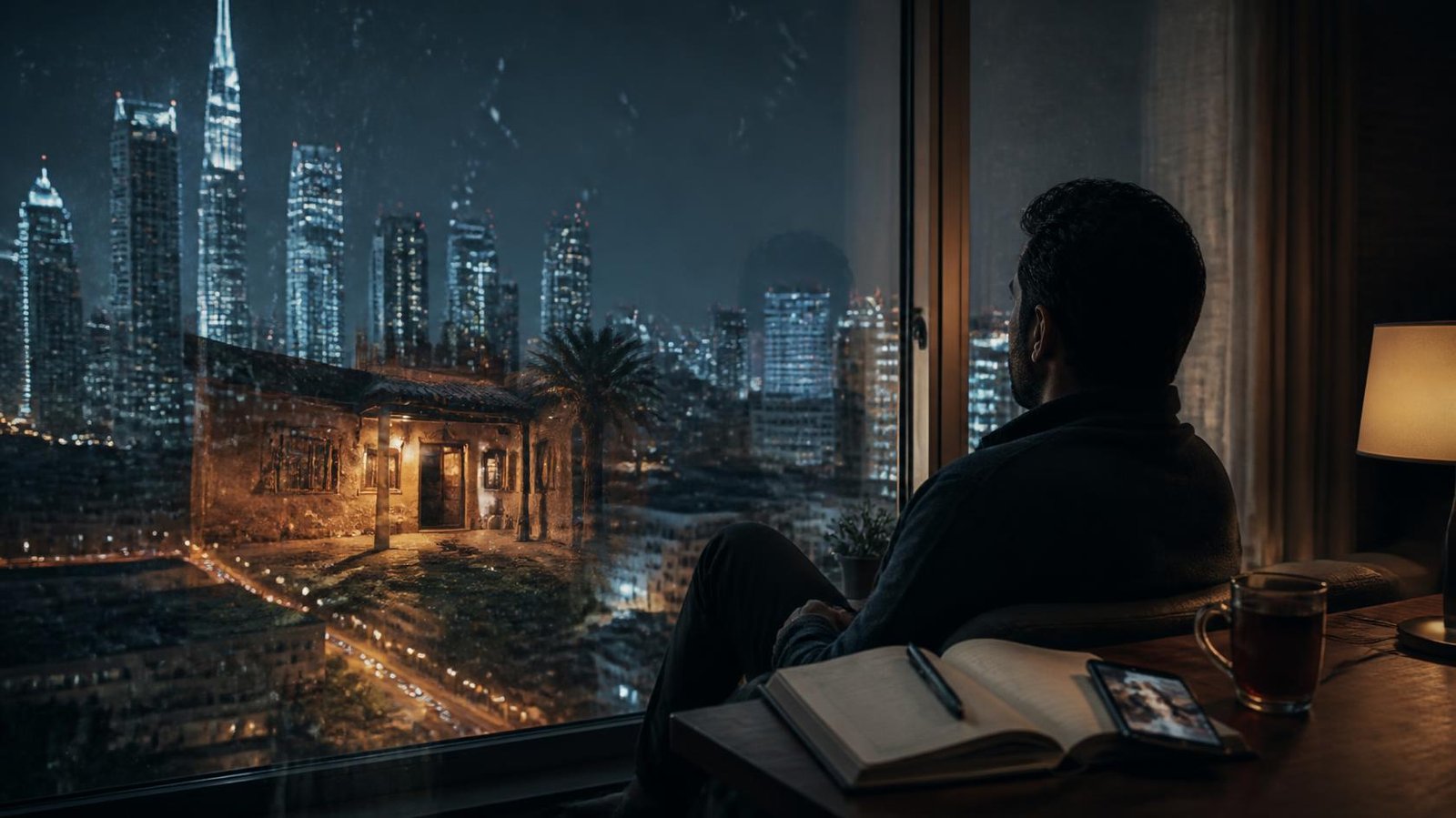
- Sami sat by the window, his tea long cold, contemplating the years he had spent waiting for a life that felt perpetually out of reach.
NavigationIn this article
Snow fell silently behind the glass, as if it knew the night disliked noise.
Sami sat on the chair near the window; the cup of tea in front of him had gone cold twenty minutes ago, and the city beneath him was illuminated by thousands of lights that did not know his name. He had just finished a short call with his mother and placed the phone on his lap, the screen still glowing with an old photograph: him at eighteen, standing between his siblings in front of the house, laughing with an open mouth that looked nothing like his smile now.
He did not cry. He was not the type to cry easily.
He did something stranger than crying: he took out a small notebook he used to track his bills and wrote a number on a blank page.
19
Nineteen years he had spent here. He left when he was twenty-six, and now he was approaching forty-five. He counted the holidays he had missed: nineteen Eids, nineteen Feasts of Sacrifice, two funerals he could not attend, and three weddings he witnessed only through a small phone screen, telling himself the signal was weak, while knowing the truth was that he was simply far away.
Then, he wrote a question under the number, in small handwriting, as if he were ashamed of it:
How many years do I have left?
He did not mean age in the medical sense. He meant something else, something harder: How many years did he have left to be his mother's son before she became a memory?
It began, if it had a beginning, weeks ago when his old friend Waseem called and told him he had decided to return home after retirement. He said it simply, as if telling him about a change in the weather:
"That's it, Sami. I'm tired of counting. Counting how much is left, counting how much has passed, counting what's in the bank account. I want to go back to living, not calculating."
Sami laughed then, but the laughter did not make it to his chest. It remained stuck in his throat all week.
The next day, he saw a photo on his phone of his childhood friend Hussein, posted by someone in an old group. Hussein, who had been the thinnest boy in the neighborhood, had become a man with a full head of white hair and a face exhausted by something Sami did not know. He looked at the photo for a long time, then at his own reflection in the darkened phone screen, and asked himself a question he had never dared to phrase so clearly before:
Am I actually living? Or am I postponing life until I reach a stage where I can finally live?
Sami did not hate living abroad. This was a point he was always careful to clarify to himself, even in his most difficult moments.
Living abroad had given him things he would not have had if he had stayed: a small apartment in his own name, a car that didn't break down every week, a salary sufficient to send a monthly remittance to his family without feeling distressed, and a trip to Italy almost every two summers with his colleagues. He remembered those trips: delicious food, genuine laughter, the beautiful feeling of being a human who had a place in this world.
But he also remembered that this happiness always ended at the same moment: when he opened his apartment door, threw his keys on the table, and stood in a silence that no one interrupted.
There was happiness, but it was of a special kind: the happiness of something new, the happiness of a moment that is bought and then ends. As for the other happiness—the kind that happens when a person sits with his mother without looking at the clock—he began to suspect he had forgotten its taste entirely.
In the week that followed, he visited his homeland for the first time in three years, on a short vacation that did not exceed ten days.
He sat in the old kitchen with his mother and drank tea from the same cup he used when he was a student, but he noticed that his hand had become heavier than the cup. He sat with his father in front of the television, laughed at an old joke his father told for the tenth time, and felt a warmth he hadn't felt in years.
But he also noticed other things.
The street where he used to play had become narrow and filled with shops he did not recognize. Childhood friends had drifted apart: some had traveled, some were busy with their own lives, and some looked at him with a gaze he didn't quite understand, as if he had become a respected stranger, not a son of the neighborhood.
On his last night there, he sat on the roof of the house alone, looked at the stars that had not changed, and realized something painful he could not tell anyone:
He, too, had become a stranger to his homeland, yet he had not become a full son of the country where he lived.
Neither here was his complete home, nor there was his complete home. He had become a man suspended between two places, owning neither of them completely.
After returning to his life abroad, he sat one evening with Waseem in a small café, with snow falling again behind the glass.
Waseem said, stirring his coffee slowly:
"Sacrifice must end one day, Sami. If it doesn't end, it becomes an escape."
Sami replied quietly:
"And if I go back now, what happens to all the years I sacrificed? My parents' house was built from this toil. My brother went to university from this toil. Can I regret a sacrifice that saved the future of people I love?"
Waseem was silent for a moment, then said:
"No one asked you to regret what you did. But you can ask yourself: how long do you want to sacrifice? Life isn't a bank account; you don't get interest back on it."
Sami said:
"And if I go back and don't find work? And if I go back and become a burden on my family instead of being their support?"
Waseem answered him:
"And if you don't go back, and you stay here, and you reach the age of sixty alone, with lots of money and no one around you who has known you for a long time?"
Sami did not answer. He had no answer. And both of them knew that both were partially right, and that the truth did not resemble a straight line between one correct opinion and another incorrect one, but rather resembled this falling snow: every white flake looks like the other, but not one of them repeats itself.
Two weeks later, he received two pieces of news on the same day.
The first: A promotion offer at work, with a significant salary increase, but it meant at least three additional years of commitment here.
The second: A call from a friend back home telling him there was a small job opportunity, modest in income, but real, in his city, minutes away from his parents' house.
Sami stood in his kitchen, the two phones in front of him on the table, and felt for the first time that the decision was no longer just an idea he thought about before sleep, but a real choice knocking at his door.
He opened his small notebook again, to the page where he had written the number 19, and remembered himself twenty years ago, a young man telling himself with the confidence of one who does not yet know time:
I will endure now, and when I grow older, I will rest.
And he asked himself now, in a voice that did not leave his mouth:
And what if the meaning of life is to experience some rest now, not to postpone it all to a time we might never reach?
He did not write an answer under the question. He closed the notebook, placed it on the table between the two phones, and sat watching the snow fall behind the glass, without sound, as if the night itself were waiting for a decision that no one could give but him.
No one told us what he did in the end. And perhaps that is not as important as the question he left behind, hanging in the air, for everyone who reads his story:
How much of your life can you pay as the price for the life you are waiting for? And when does waiting stop being wisdom, and become just another name for fear?
Continue the conversation in the community and share your ideas with readers and writers.Have a thought or question about this article?

Comments 0
Share your thoughts respectfully. Abusive or disruptive comments may be hidden.