



Quick summary
- Can a book change a person's life forever, or drive them toward fear, obsession, and perhaps madness?
- This is the story of Shams al-Ma'arif al-Kubra, a text linked for centuries to the supernatural.
NavigationIn this article
By: Ahmed Salem
Can a book change a person's life forever, or drive them toward fear, obsession, and perhaps madness?
The question may seem exaggerated; after all, a book is nothing more than papers gathered between two covers. But it becomes less strange when the discussion turns to a book whose name has been linked, for centuries, with magic, talismans, jinn, and secrets that humans were supposedly never meant to know.
It is Shams al-Ma'arif al-Kubra (The Great Sun of Gnosis), a book whose mere mention in a gathering is enough to change the tone of conversation. Some begin to recount tales of locked rooms, unknown voices, and individuals who read pages from it and were never the same again.
There are those who see it as an ancient treatise on the science of letters and magic squares, around which legends larger than its reality have been woven. Others believe it is a gateway to a hidden world, and that tampering with its contents may open doors that a human being is incapable of closing.
But why did this book acquire such a reputation? Who is the man to whom it is attributed? And are the terrifying stories associated with it real, or are they the result of fear, suggestion, and folk imagination?
To answer that, we must go back centuries, to a time when the boundaries between astronomy, Sufism, magic, and philosophy were less clear than they are today.
Who is Ahmad al-Buni, the Author of Shams al-Ma'arif?
The book Shams al-Ma'arif al-Kubra is attributed to Ahmad ibn Ali al-Buni, a scholar and Sufi who lived during the Middle Ages and was famous for his interest in the science of letters, names, numbers, and symbols.
The man carried the title "al-Buni" in reference to the city of Bouna, known today as Annaba in Algeria. Historical accounts mention that he traveled between several countries and was interested in Sufism and religious sciences, alongside fields that were considered part of secret knowledge in his era.
In that time, the science of letters was not merely a linguistic study of the shape and sound of a letter. Some researchers and Sufis believed that every letter had a numerical value and a specific energy, and that arranging letters and numbers in specific shapes could carry meanings that transcend the apparent sense of the words.
From here, the image of Ahmad al-Buni began to grow more mysterious.
Some saw him as a spiritual scholar searching for the secrets of the universe and the relationship between numbers, letters, and existence. Meanwhile, others accused him of delving into the realms of magic and seeking the aid of invisible forces.
Over time, historical facts mixed with folk tales. It was said that al-Buni spent long periods in isolation, writing, meditating, and performing complex calculations that the general public did not understand. Stories even emerged claiming that he communicated with beings from the hidden world, and that some of the information in his books was not obtained through conventional study.
There is no reliable evidence to prove these accounts, but they played a major role in creating the terrifying aura surrounding his personality and his most famous book.
How Did Shams al-Ma'arif al-Kubra Appear?
It is difficult to determine the exact moment when Shams al-Ma'arif appeared in the form known today. The circulated copies differ in their page counts, the arrangement of their chapters, and their content. Furthermore, some researchers doubt that all its parts are attributed to Ahmad al-Buni himself.
It is likely that the original text was subjected, over hundreds of years, to additions, deletions, and re-arrangements. Scribes used to copy books by hand, and some might add comments or texts from other sources, which then became part of the book over time.
For this reason, it cannot be stated with certainty that everything in modern editions was actually written by al-Buni.
However, this ambiguity did not weaken the book's reputation; it strengthened it. The idea of a lost original version, different from all existing copies, opened the door to dozens of legends.
It was said that the first version contained more dangerous chapters, and that some sections were intentionally deleted so that their secrets would not fall into the hands of the public. Other stories circulated that scholars and religious figures burned copies of it or hid them in vaults where no one could reach them.
Some folk tales even went so far as to claim that the original version did not disappear by human hands, but was taken by beings from the hidden world so that humans would not see what was inside.
Of course, none of these stories can be proven, but they reveal the extent of the fear associated with the book across generations.
What is Inside the Book Shams al-Ma'arif?
When looking at some of the copies attributed to Shams al-Ma'arif al-Kubra, the reader finds themselves before extremely complex and strange material. The book does not follow the method of traditional works; rather, it combines multiple subjects where letters, numbers, geometric shapes, names, supplications, and astronomical calculations overlap.
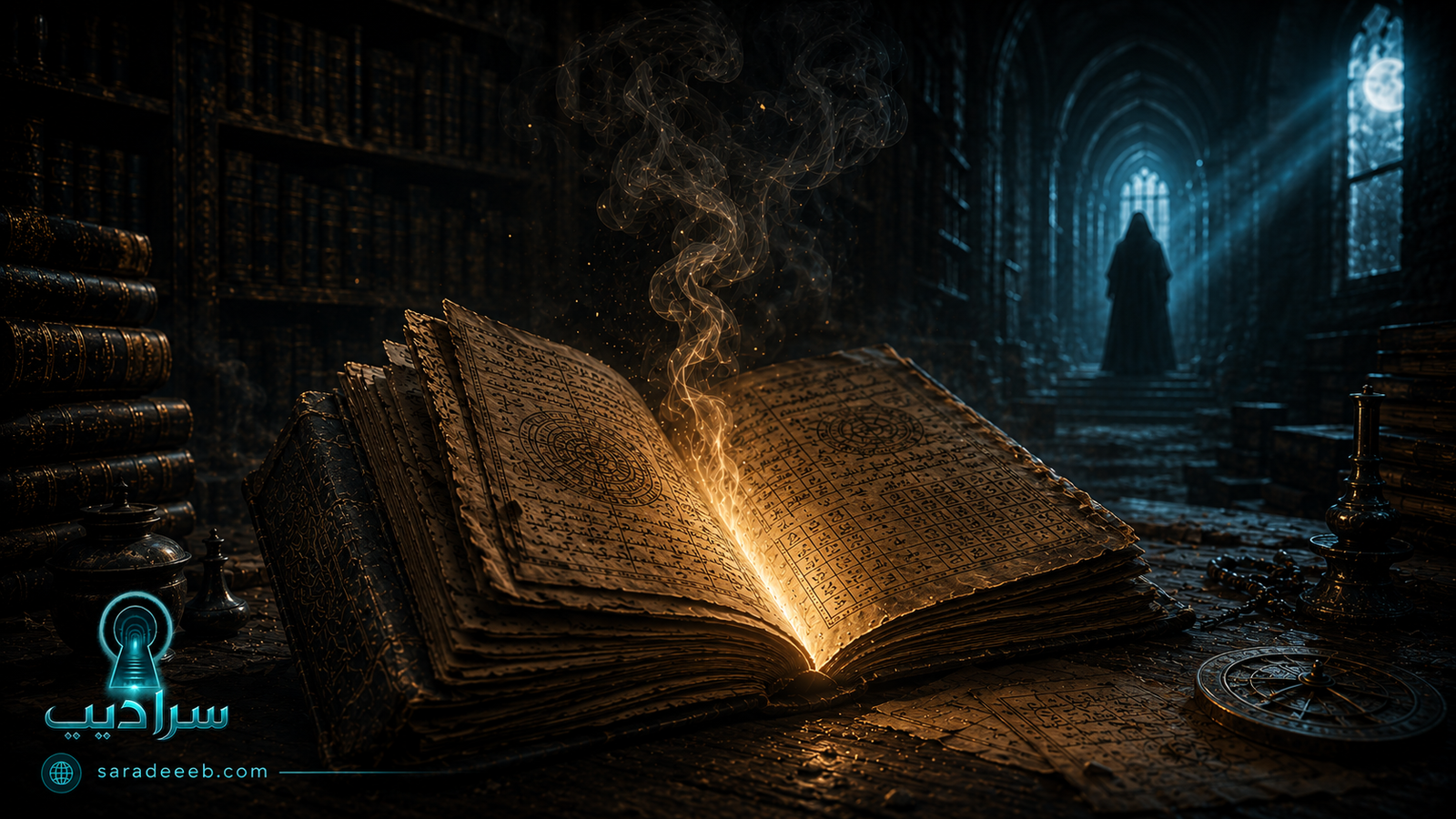
On its pages, square tables divided into cells appear, containing numbers or letters arranged in specific ways. These tables are often known as Awfaq (magic squares), and they are among the elements that most contributed to the book's fame and the fear it inspires.
The book also speaks about the properties of letters and their relationship to numbers, planets, days, and hours. It presents ancient concepts claiming a correspondence between the movement of celestial bodies and certain events that occur on Earth.
It also contains mysterious symbols and phrases that are difficult to understand, especially for the non-specialist reader. Some words may be written in an unfamiliar way, with unknown names, or in arrangements that seem to have no clear meaning.
This ambiguity makes the reader feel as though they are facing a code, not an ordinary book.
Although the book includes religious texts, supplications, and names of an Islamic nature, their presence alongside talismans, magic squares, and mysterious practices has sparked widespread objections. Many religious scholars saw the mixing of sacred texts with practices of magic and sorcery as dangerous and unacceptable.
For this reason, the name Shams al-Ma'arif al-Kubra is no longer associated with the science of letters alone; it has transformed in the popular consciousness into one of the most famous books of magic in the Arab world.
Shams al-Ma'arif, the Jinn, and the Hidden World
What is most terrifying about the book is its association with the jinn and invisible beings.
Stories circulate that some of its chapters speak of names and methods alleged to help communicate with hidden forces or seek their assistance. However, many copies differ in the details of these texts, and it is difficult to know what is original and what was added in later periods.
The danger lies not in the existence of the symbols alone, but in the belief that reading or chanting them might lead to a real result.
Some people deal with these matters as ancient myths with no effect. Meanwhile, others believe that the words and symbols may represent pacts or calls directed to beings that humans cannot see.
Between these two views, thousands of stories have emerged about people who opened the book out of curiosity, only to feel that something strange began to happen around them.
These experiences may be the result of pre-existing fear, lack of sleep, or excessive focus on sounds and shadows. When a person reads frightening material, especially at night and in isolation, they become more attentive to any natural movement or sound.
The creak of an old door might seem like footsteps to them.
The shadow of a tree behind the window might transform in their eyes into a person watching them.
And the sound of wood expanding in the house might seem like knocking coming from inside the walls.
But for those who lived the experience, these explanations are not always sufficient. They do not see what happened as a mere coincidence; rather, they consider it evidence that they approached something they should not have approached.
The Story of the Young Man Who Bought an Old Copy
In some gatherings, a story is told about a young man who was interested in rare books. He used to visit old book markets, searching for manuscripts that bore strange seals or notes written by their previous owners.
One day, he found an old book with no clear title at an elderly vendor's stall. Its cover was dark, its pages were yellow, and at its beginning, the name Shams al-Ma'arif was written in faint script.
The young man asked about the price, and the vendor asked for an unexpectedly small amount. As he was about to leave, the man said to him:
“Take it for reading only, and do not try to experiment with anything in it.”
The young man laughed, thinking the vendor was trying to increase the book's value by frightening him.
On the first night, he read several pages and nothing happened. He found tables, letters, and numbers he did not understand, then closed the book and placed it next to his bed.
After midnight, he woke up to a sound like the rustling of paper. He thought the room window was open, but he found it closed. When he looked at the table, he saw the pages of the book moving slowly, even though it had been closed before he went to sleep.
He convinced himself that the air was the cause and closed it again.
The next night, he heard a light knocking on his room door. He opened the door and found no one. The knocking was repeated three times, and each time the hallway was empty.
After a few days, he began to see a quick shadow in the corner of his eye. Every time he turned, he found nothing.
This story was not documented, and we do not know if the young man ever existed. But the narrator claims that he burned the book in the end, and that the sounds did not disappear until many weeks later.
Like many stories of Shams al-Ma'arif al-Kubra, this account was passed from one person to another, and each time it gained new, more terrifying details.
The House Where the Family Could Not Stay
There is another story about a family living in an old house on the outskirts of a village. The father, while cleaning an abandoned room, found papers hidden inside a wooden box.
The papers contained square symbols and incomprehensible writings. One of his acquaintances told him that they were pages taken from the book Shams al-Ma'arif, and that they might have been used in the past for purposes related to bringing money or protection.
Instead of getting rid of them, the father kept them and began to read about them out of curiosity.
Shortly thereafter, the family began to hear the sound of footsteps on the roof of the house at night. The father would go up to check the place, but would find no one.
Then doors began to open at late hours, even though they made sure to lock them. The mother would sometimes wake up to find some items had moved from their places.
The fear reached its peak when the family's child told his mother that he talked every night with a “tall man” standing near the room door.
The family left the house and only returned during the day to collect their belongings.
Once again, there are no documents to prove the story, and its events may be the result of natural sounds in an old house or fear passed from parents to children. However, such stories helped solidify the image of the book as something that should not be kept inside the home.
Why Do People Fear Shams al-Ma'arif al-Kubra?
The fear of the book is not linked to its content alone, but to the way society deals with it.
Humans usually fear what they do not understand. When one sees unknown symbols, unfamiliar names, and numbers arranged in a mysterious way, the mind begins to try to find meaning for them.
Then come the inherited warnings to double the effect.
“Do not open it at night.”
“Do not read it out loud.”
“Do not keep it in the bedroom.”
“Do not look long at the tables.”
These warnings make the reader enter the experience psychologically prepared to expect danger. Every sound after that becomes a sign, every disturbing dream turns into a message, and every coincidence seems to be a result of what they read.
This effect is known psychologically as the power of suggestion. A person who expects something scary to happen becomes more capable of noticing details that confirm their fear and ignores details that negate it.
But the power of suggestion does not mean the experience is simple. Some people may enter states of severe anxiety, obsession, or insomnia, especially if they already believe that the book is capable of harming them.
Thus, the book may destroy a person's life, not necessarily because of a supernatural power, but because of the fear it planted inside their mind.
The Stance of Religious Scholars on the Book Shams al-Ma'arif
A large number of religious scholars have warned against reading books of magic and talismans or experimenting with what they contain. This is because they contain practices that may be based on seeking the help of jinn, using phrases of unknown meaning, or mixing religious texts with acts of sorcery.
Furthermore, some talismans may contain words whose meaning or the entity they address the reader does not know. For this reason, scholars believe that chanting or using them represents a religious and psychological danger.
The presence of verses or supplications inside a book does not mean that all its contents are correct or legitimate. Sacred texts may be used in deviant contexts to convince the reader that the mysterious work carries a religious character.
Therefore, specialists advise against trying any unknown practice and not dealing with the book as a means to obtain money, love, power, or knowledge of the future.
Curiosity may begin with reading a page, then turn into a continuous search, dangerous experiments, and isolation from people, and perhaps into falling victim to charlatans who exploit fear and need.
Is Shams al-Ma'arif al-Kubra a Real Book or a Legend?
The book actually exists, and there are copies, manuscripts, and multiple editions of it. However, many of the legends associated with it are not based on clear historical evidence.
There is no proof that merely touching the book or reading it automatically leads to the appearance of jinn or the occurrence of supernatural events. Furthermore, the stories spread about it are often told without full names, dates, or sources that can be verified.
But this does not make the book free of danger.
The danger may be intellectual, psychological, and religious. A disturbed or highly impressionable person may try to apply mysterious practices, entering a cycle of fear, isolation, and delusions.
Also, some people exploit the name Shams al-Ma'arif al-Kubra to deceive others, claiming to possess its secrets or the ability to use it to solve problems, then asking for money or imposing harmful practices on their victims.
Therefore, a balanced view does not need to deny the existence of the book, nor to believe every terrifying story told about it. It is enough to realize that it is a complex historical work in which ancient ideas mixed with mysterious practices, and then folk imagination added thick layers of horror around it.
The Mystery of the Original Version of Shams al-Ma'arif
The issue of the original version remains one of the most mysterious aspects.
The editions available today are not identical. Some are abridged, some carry additions, and some attribute to al-Buni texts that may have appeared after his death.
Some researchers believe that what is called today “Shams al-Ma'arif al-Kubra” may be a collection of texts gathered across different periods, and not a single book that reached us exactly as its author wrote it.
But this possibility did not prevent the emergence of stories about a complete version hidden in an unknown place.
One legend says that the original version was kept in a private library and is only allowed to be seen by specific people. Another says it was burned after its owners realized the danger of what it contained.
As for the strangest accounts, they claim that al-Buni himself hid parts of it because he feared that people would use it for harm and revenge.
Perhaps we will never know the truth. Thousands of ancient manuscripts were lost due to wars, fires, and neglect, and the fate of the first version may be much simpler than the legends surrounding it.
However, the unknown is always more exciting than the simple truth.
Shams al-Ma'arif in the Modern Era
Despite the passage of centuries since the book's appearance, its fame has not declined. Rather, the internet and social media sites have contributed to bringing it back to the forefront.
Clips talking about the “secrets of the book,” images of mysterious tables, and experiences whose owners claim they lived after reading some of its pages have spread.
Some content creators use its name to attract views, presenting exciting titles such as “The Forbidden Book,” “The Book That Summons Jinn,” or “The Most Dangerous Book in History.”
These exaggerations make new generations more curious about it.
But the problem is that some teenagers may try to imitate what they watch without realizing the psychological or religious consequences. An experience that began as a challenge may turn into permanent anxiety, insomnia, or fear of being alone.
Therefore, content related to magic and talismans must be handled with caution, and not everything presented on the internet should be considered a fact.
Between Fact and Myth
Shams al-Ma'arif al-Kubra stands in a gray area between history and legend.
It is a real book in terms of existence, but over time it has transformed into a symbol of fear of the unknown world. Its reputation has become larger than its pages, so much so that many who fear it have never seen or read it.
Perhaps al-Buni was a Sufi researcher who wrote according to the concepts of his time, and perhaps texts were later added to his works that made them closer to books of sorcery. And perhaps the terrifying stories were just folk tales fueled by fear and suggestion.
But what is certain is that the book touched a deep side of the human soul: the desire to know what is behind the veil.
Since ancient times, humans have dreamed of knowing the future, controlling luck, bringing money, subjecting others, and revealing secrets. Whenever a means appeared before them claiming to achieve these desires, they approached it despite the fear.
And here lies the danger of curiosity.
A person does not always open the door because they are brave, but because they think they are capable of closing it whenever they want.
Conclusion: Is Curiosity Worth All This Price?
Shams al-Ma'arif al-Kubra may not be a book that releases supernatural powers just by opening its pages, as some tales portray it. But it is certainly a book surrounded by centuries of fear, warning, and mysterious stories.
The truth remains hidden behind layers of incomplete manuscripts, additions, legends, and accounts that are difficult to prove.
But the most important question is not whether the book is capable of summoning something from the hidden world.
The question is: what can it summon inside the reader's mind itself?
It may awaken fear, plant obsession, and make a person see a threat in every shadow and hear messages in every sound. It may drive them to chase secrets that do not grant them the power they seek, but rather rob them of the peace they possessed.
Books do not always need supernatural powers to change human lives. Sometimes one idea is enough, if it settles deep in the mind, to turn the night into a space of terror, and the safe home into a place filled with hidden eyes.
And perhaps this is why the name Shams al-Ma'arif has remained alive until today.
Not because anyone has proven what is said about it, but because mystery does not die easily, and because humans will always be attracted to closed doors, even when it is clearly written on them:
Do not open.
Author: Munir
Have a thought or question about this article?
Continue the conversation in the community and share your ideas with readers and writers.

Comments 0
Share your thoughts respectfully. Abusive or disruptive comments may be hidden.