



Quick summary
- The blood that covered my hands was not my own.
- It was the first thing I realized when the lighter's flame pierced the darkness that had swallowed us whole.
NavigationIn this article
By: Ramadan Mustafa Muhammad
The blood that covered my hands was not my own.
It was the first thing I realized when the lighter's flame pierced the darkness that had swallowed us whole. The place was filled with the smell of rust and rotting earth, but the scent of blood was more intense; a fresh, metallic odor that clung to my throat and stirred nausea in my stomach.
I looked at Ali. He was holding the lighter with a hand that trembled violently, causing the flame to dance over our pale faces. His eyes were wide with terror, staring at something behind me, while his tongue seemed tied, unable to speak.
I turned my head slowly, as if my neck were a rusted hinge, and saw what he was staring at.
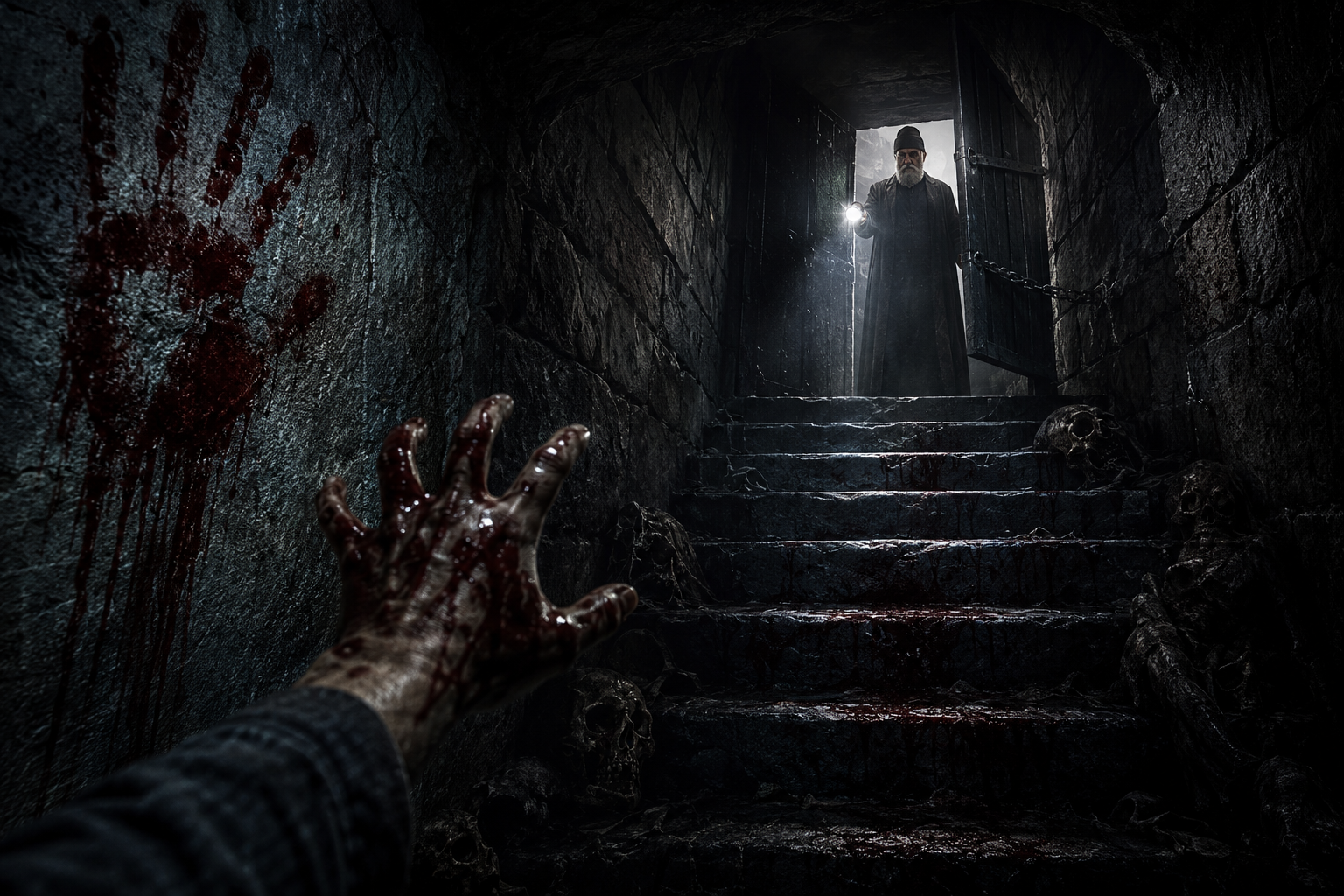
On the stone wall behind us appeared a handprint dipped in blood. It was a large hand, with finger marks trailing downward, as if its owner had clung to the wall while something dragged them into the darkness.
It was not the handprint that terrified me.
What truly terrified me was that we had entered this cemetery as three people: Ali, Muhammad, and I.
But now, Muhammad was not with us.
A heavy silence prevailed, broken only by our ragged breathing and the sound of something viscous being slowly dragged over the steps we had descended.
I whispered, fearing my voice might wake something sleeping beneath our feet:
“Where is Muhammad?”
Ali did not answer. He remained staring at the wall until the lighter grew hot between his fingers and burned him, causing it to fall from his hand and extinguish on the floor.
The darkness swallowed us once again.
I retreated until my back hit the wall, feeling the coldness of the stone seep through my clothes. At that moment, my mind drifted back two hours, to when we were sitting in the café after dinner.
Muhammad was laughing, saying that all the stories told about the Cursed Cemetery were nothing but myths invented by mothers to keep children from playing among the graves at night.
That place had always captured my curiosity. The cemetery was located at the far end of the village, built from black stones different from those of other graveyards. It had a rusted iron door, surrounded by a thick chain for which no one knew the key. Not a single tree or blade of grass grew around it, as if the earth itself refused to grant life to anything that approached it.
We agreed to wait until the village fell asleep.
In the countryside, the roads are empty two hours after dinner, with nothing left but the barking of stray dogs. But that night was different. From the moment we left the houses and headed toward the graves, we did not hear a single dog bark.
The silence was suffocating, as if the air itself had been drained of life.
When we reached the iron door, Muhammad pulled out a small crowbar he had stolen from his father's workshop and began smashing the old lock. The iron emitted a sharp screech, and every strike made my heart jump into my throat.
After several attempts, the chain broke and fell to the ground with a muffled thud.
The door opened on its own.
It moved slowly, as if it had been waiting for our arrival, and then a cold draft of air rushed from behind it, heavy with the scent of old camphor and damp earth.
The three of us entered.
I was holding my phone to light the way, Ali was behind me, and Muhammad led the way. The inner courtyard was unlike any cemetery we had ever known. There were no tombstones or mounds of dirt, but rather a narrow stone staircase descending deep into the bowels of the earth.
We should have turned back at that moment.
Graves in our village were not dug this way; the groundwater is close to the surface, and the villagers say the earth rejects its dead if they are buried too deep.
But curiosity drove us to descend.
Or perhaps it wasn't curiosity.
Perhaps there was something down below pulling us toward it.
We descended step after step, and the light of my phone dimmed the deeper we went, as if the darkness were slowly devouring it. After about fifteen steps, we reached a vast underground hall.
The walls were covered with deep scratches. They were not writings or inscriptions, but claw marks gouged into the stone, as if many people had tried to claw their way out with their bare hands.
Suddenly, the phone's light went out.
The battery hadn't died; the screen simply went completely black, and the phone turned into a cold piece of metal between my fingers.
I called out to Muhammad.
He answered that he would turn on his phone's light. I heard a quick movement, then the sound of unsteady footsteps.
And then, I heard nothing.
Muhammad didn't scream, didn't fall, and didn't call for help. His voice vanished as if the darkness had swallowed him.
That was when Ali lit his lighter, and we saw the bloody handprint on the wall.
I returned to the present, crouching in the darkness, feeling the ground in search of the lighter. My fingers touched something warm and viscous, and I pulled my hand away quickly, wiping it on my pants while shivering.
I said in a broken voice:
“Ali, are you still with me?”
A hand reached out from the darkness and gripped my arm. It was deathly cold, and its bones were as hard as stone.
I heard his voice say:
“I am here, Hassan. We must leave. This place does not want us.”
His voice sounded different. It was hoarse, with a faint echo, but fear prevented me from dwelling on that.
I stood up and pulled him with me toward where I thought the stairs were. We felt for the steps with our feet, then began to climb.
One step, then two, then ten steps and twenty.
The staircase hadn't been this long when we descended.
We had only gone down about fifteen steps, but we had been climbing for minutes now, without the door appearing at the top.
The further we went, the narrower the passage became, the air grew heavy in my chest, and the smell of blood intensified until I felt as if I were breathing inside an open wound.
I stopped, gasping, then looked behind me.
I couldn't see Ali's features, but I felt his presence pressed against my back, his hand still gripping my arm.
I said, trying to swallow my dry saliva:
“Ali, we are climbing in the right direction, aren't we?”
No answer came from behind me.
Ali's voice came from below, from the depths of the hall we had left.
He was screaming in a muffled voice, like a drowning man trying to catch his breath:
“Hassan! Don't leave me here! Hassan!”
I froze in place.
If Ali was down below, then who was holding my arm?
I felt the blood drain from my face. The grip on my arm tightened until I imagined my bones would shatter.
I couldn't move or turn to see what was standing behind me. Its breath hit the back of my neck, and it was not human breath. It carried the scent of fermented earth and rotting flesh.
I tried to free my arm, but the grip was like steel.
Then I heard a whisper right by my ear.
The voice was Muhammad's, but it came slow and distorted, as if he were speaking from the bottom of a well:
“The cemetery does not return those it takes, Hassan. It only replaces them.”
I gathered all the strength left in my body. I shoved the creature standing behind me and violently shook off its arm.
I heard a heavy body tumble down the steps, followed by the sound of bones shattering against the stone, but no scream of pain followed.
I didn't look back.
I rushed upward, stumbling, falling, then rising. The rough walls cut my palms and arms, and I couldn't see anything in front of me, but I kept climbing.
Suddenly, my head struck a solid object.
I felt it with my hand and realized it was the iron door.
It was locked.
I didn't understand how it had closed, as we had left it open when we entered. I began pounding on it with both hands until the skin on my fingers tore, and I screamed at the top of my lungs:
“Open the door! Can anyone hear me? Father! People of the village!”
But my voice echoed back to me, as if the place were isolated from the world outside.
I kept pounding until my strength failed, then I sat on the ground and leaned my back against the door. I put my head between my knees and cried like a child.
All the stories my mother used to tell to scare me seemed real at that moment, but she had never told me that the cemetery was a living thing, and that it fed on those who entered it.
And while I was drowning in despair, a faint thread of moonlight appeared from under the door. Then I heard the sound of light footsteps approaching from the outside.
I lifted my head and pressed my ear against the cold iron.
I heard someone moving the chain.
Hope returned to my heart, and I screamed:
“I’m here! Open the door, please!”
The door opened slowly, and its screech at that moment was the sweetest sound I had ever heard in my life.
Light rushed inside, blinding me for a few seconds. I closed my eyes, then opened them to see an old man standing outside, holding a powerful flashlight.
It was Uncle Saber, the cemetery guard.
The villagers feared him because he didn't speak to anyone and lived alone among the graves. He stared at me with narrow eyes, then passed the flashlight beam over my face and clothes.
He said in a raspy voice:
“What brought you into this courtyard, my son?”
I stood up, shivering, and clung to his robe as if it were my last lifeline.
I said, stuttering:
“Uncle Saber, save me. Muhammad and Ali are still down there. We entered together, then something dragged them away. The door locked on us, and I… I…”
I couldn't finish my sentence.
Uncle Saber remained silent. His expression didn't change, but his flashlight beam settled on my shirt.
I looked at the spot he was staring at.
There was a bloody handprint on my chest, similar to the one we had seen on the wall. But this time, the fingers were pointing upward, as if someone had tried to drag me down and had gripped my clothes.
Uncle Saber slowly raised his eyes to mine, then said:
“Muhammad and Ali, who? I have guarded this place for forty years, and I am the one who buried Muhammad and Ali with my own hands in this courtyard fifteen years ago.”
I took a step back.
I couldn't understand his words.
Fifteen years?
I had been sitting with them in the café two hours ago. We talked, laughed, and planned to come here together. I had known them since my childhood.
I looked at the road stretching behind Uncle Saber. It was completely empty, bathed in moonlight.
At that moment, the phone in my pocket vibrated.
The phone that had gone dead down below.
I pulled it out with a trembling hand; its screen lit up, and a message appeared from an unknown number:
“Are you the one who climbed out, Hassan, or are we the ones who came out with you?”
I raised my eyes toward Uncle Saber.
He wasn't looking at me.
He was staring into the darkness behind me, inside the courtyard. A rigid smile appeared on his face, devoid of any trace of life.
Then he said, reaching out to close the door:
“Welcome to your new home, Muhammad.”
The iron door slammed shut in my face, and the chain returned to its place.
But this time, I was not on the outside.
I was on the inside.
And Ali and Hassan were standing beside me in the darkness, waiting for the next dinner.
Author: Ramadan Mustafa Muhammad
Have a thought or question about this article?
Continue the conversation in the community and share your ideas with readers and writers.

Comments 0
Share your thoughts respectfully. Abusive or disruptive comments may be hidden.